
In January 2016, I had the good fortune of returning to Burma (Myanmar) on another great Within The Frame photography adventure, this time focusing on the fascinating – and vanishing – minority tribes of Burma. We visited with several remote tribes, taking planes, boats, cars, and even hiking, to reach people who live far removed from the mainstream.
My intention was to visit with these individuals, and to try and capture their souls and spirits in the most culturally sensitive way possible. I knew our guide, Shine, from a previous trip to Myanmar, and had the upmost confidence in his abilities to make this a memorable experience for me. What I didn’t foresee was the profound calm, strength and beauty of these people, who live outside the conventional “norms” that we are all so used to in the western world.
I do not believe that beauty can be defined, it’s parameters reduced to measurements and metrics. To me, beauty is something that lies deep within a person; it is something that radiates out or is displayed in acts of kindness, gentleness or movement. The women I met and photographed in Burma – though unconventional in their appearance – were all beautiful to me.
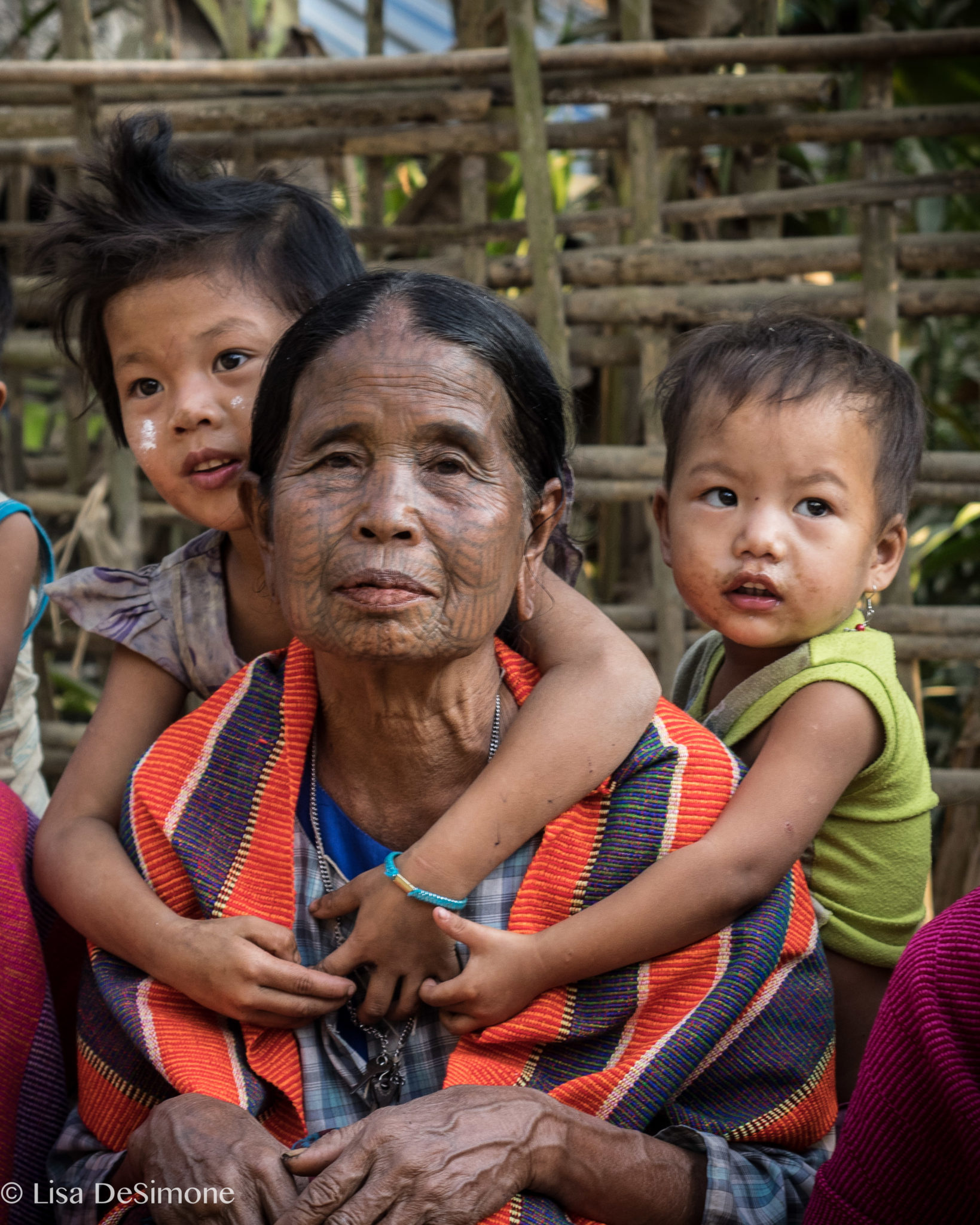
The Chin Tribe
The Chin women with tattooed faces are a dying breed: what used to be common practice is performed no longer. We traveled by boat to visit three small, remote villages where some of the remaining tattooed women live. They were sweet, patient and agreeable to having their photos taken, as our guide explained to them that we wanted to share their dying history with others.
It is said that the tattooing of faces was a mark of strength, beauty and womenhood: the women we spoke to said they got their first tattoos as early as 10 years old. The actual tattoo pattern varies according to tribe: the spider web pattern with the rising sun at the forehead on these women’s faces is the most common.


Spending time among these people was an amazing and unique experience I won’t soon forget. My most memorable moments included interacting with a 102 year old nun (her tattoos now hidden by wrinkles) and being invited to join a group of women on their bamboo mat for a good old-fashioned “chat”!

The Ann (or Enn) Tribe
We traveled to the east of Myanmar, in Shan State (basically the “golden triangle” on the border of Thailand and China) and settled in the town of Kengtung. One day we drove an hour from Kengtung, then slogged another hour on a very muddy path up to the hillside village of Panle. The village is very small, with only 23 bamboo houses, and is home to some of the only 3,000 remaining Ann (or Enn) tribal people.
 Historically the Ann were tribal hunters, and instead of being Buddhist are animists (they worship spirit animals, plants and the elements). The distinct feature of the Ann is that the women and men chew the bark of a tree thought to have medicinal powers, but also turns their teeth black. The upside I suppose is that the bark is also a stimulant!
As with the other minority groups we met, they were kind and patient, and willing to let us photograph them. As a gesture of thanks (and to receive good karma) we bought some handmade jewelry, brought medicine, and handed out warm clothes for the children (as it tends to be very chilly in the hills).
The Akha Tribe
On our second day in the far east corner of Myanmar we hiked into the mountains through some pretty dense fog to visit the Akha tribe in the village of Ho Kyein Ntet. The Akha are an indigenous tribe who live in small villages at higher elevations in the mountains of Thailand, Burma, Laos and certain parts of China.
Like other minority tribes we visited, the Akha are animists. Entrances to all Akha villages are fitted with wooden “spirit gates” which functions to ward off evil spirits from entering the village. Upon our arrival, we had lunch in the hut of the village hunter, who hunts crows and then dries/smokes the beaks and sells them to other villagers who hang the open beaks at their doorway to ward evil spirits from their homes.


Once the villagers heard there were foreigners around, they all came out to have a look! The Akha are noted for their elaborate handmade headdresses, with the different styles denoting their marital status. The headdress consists of a bamboo core covered with embroidered cloth, silver studs, balls and coins (rupees for the rich) and colorful beads. Seeing these women come out of the fog wearing their headdresses was mystical and amazing. Equally as amazing to me was the fact that the women wear these elaborate headdresses and traditional clothes as part of their everyday life. We didn’t see a foreigner the entire day, which made it even more special.
The Padaung Tribe
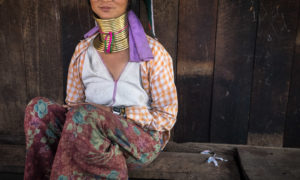
After a few airplane take-offs and landings, and a 7 hour bus ride in the dark, we arrived late one night in the town of Loikaw, which is located in eastern Myanmar (in Kayah state), on the border with Thailand. Our goal was to visit the Kayan village of Panpet. The Kayan women in this minority group are also known as Padaung, and are most recognized by the long brass coils they wear around their necks.
According to our guide, there are roughly 25,000 Kayan people in this state, with another 40,000 in southern Shan State. In the late 1980s and early 1990s due to conflict with the military regime in Myanmar, many Kayan tribes fled to the Thai border area. Among the refugee camps set up there was a “long neck section”, which became a tourist site, self-sufficient on tourist revenue.

In the recent past, many of the Kayan came back to Myanmar, and the village we visited – while only an hour outside of Loikaw – did not feel overly touristy. There were only a few other foreigners there, and the general feeling in the village was one of peace and calm….there was no clamoring to sell us things (although there were handicrafts for purchase, and we did our part to help the local economy). The Kayan women simply went about their business, and allowed us to photograph them when asked. They were beautiful, patient, and so very gentle.
Kayan girls first start to wear rings when they are around 5 years old. Over the years the coil is replaced by a longer one and more turns are added. The weight of the brass pushes the collar bone down and compresses the rib cage. The neck itself is not lengthened, although that is how it looks (it’s actually the deformation of the clavicle). I picked up a full set of coils, including the final last coil that goes around the collar bone, and it was extremely heavy…my guess is that it weighs about 20 lbs!
There are many different accounts of why the Padaung practice this custom. Our guide told us that their own mythology explains that it is done to prevent tigers from biting them, or that it is done to make the women unattractive so they are less likely to be captured by other tribesmen. The most common explanation, though, is the belief that an extra-long neck is considered a sign of great beauty and wealth and that it will attract a better husband. I was utterly fascinated by these peaceful, soulful women.
There are many different accounts of why the Padaung practice this custom. Our guide told us that their own mythology explains that it is done to prevent tigers from biting them, or that it is done to make the women unattractive so they are less likely to be captured by other tribesmen. The most common explanation, though, is the belief that an extra-long neck is considered a sign of great beauty and wealth and that it will attract a better husband. I was utterly fascinated by these peaceful, soulful women.

This adventure turned out to be one of the most fascinating trips I have ever taken, and it really stretched my skills as a portrait photographer. Importantly, I had to overcome my reluctance to approach people and ask to take their photos…I find this particularly hard when I don’t speak the same language.
I quickly learned that a great deal can be accomplished through hand signals! While our local guide did help some, I knew that it was up to me as a photographer to make a connection with the person in order to truly capture their spirit in my images.
What experience has pushed you past your comfort zone, but left you exhilarated and feeling alive? Leave your answers in the comment section below!
Click here to view the full gallery of images from my trip to Burma.
Click here to be directed to my photography website where you can view images from all of my travels

You must be logged in to post a comment.